Municipal Leaders: Develop Faster, Lead Stronger, Build Better
Every week, you’ll get insights and actionable steps to help you navigate personal growth and professional success.

You’re three weeks into budget season when a council member stops you in the hallway with another priority. Your calendar is already impossible. Your to-do list keeps growing. And somehow you’re supposed to be strategic while drowning in the tactical.
So what’s the answer?
You can’t match private sector salaries.
Your pay scales are rigid as concrete.
Your bonus structure? Practically nonexistent.
And if motivation really came down to money, you’d be watching your best people walk out the door every single day.
Except that’s not what the research shows.
When was the last time someone on your team told you something was failing before it became a crisis?
If you’re like most local government leaders, the answer is: not recently enough.
Charles Darwin changed how we understand the world. Nineteen groundbreaking books. Discoveries that shaped modern science. Meticulous experiments and global correspondence.
He worked about four hours a day.
Not because he was lazy. Because he understood something most municipal leaders have forgotten: work and rest aren’t opposites. They’re partners.
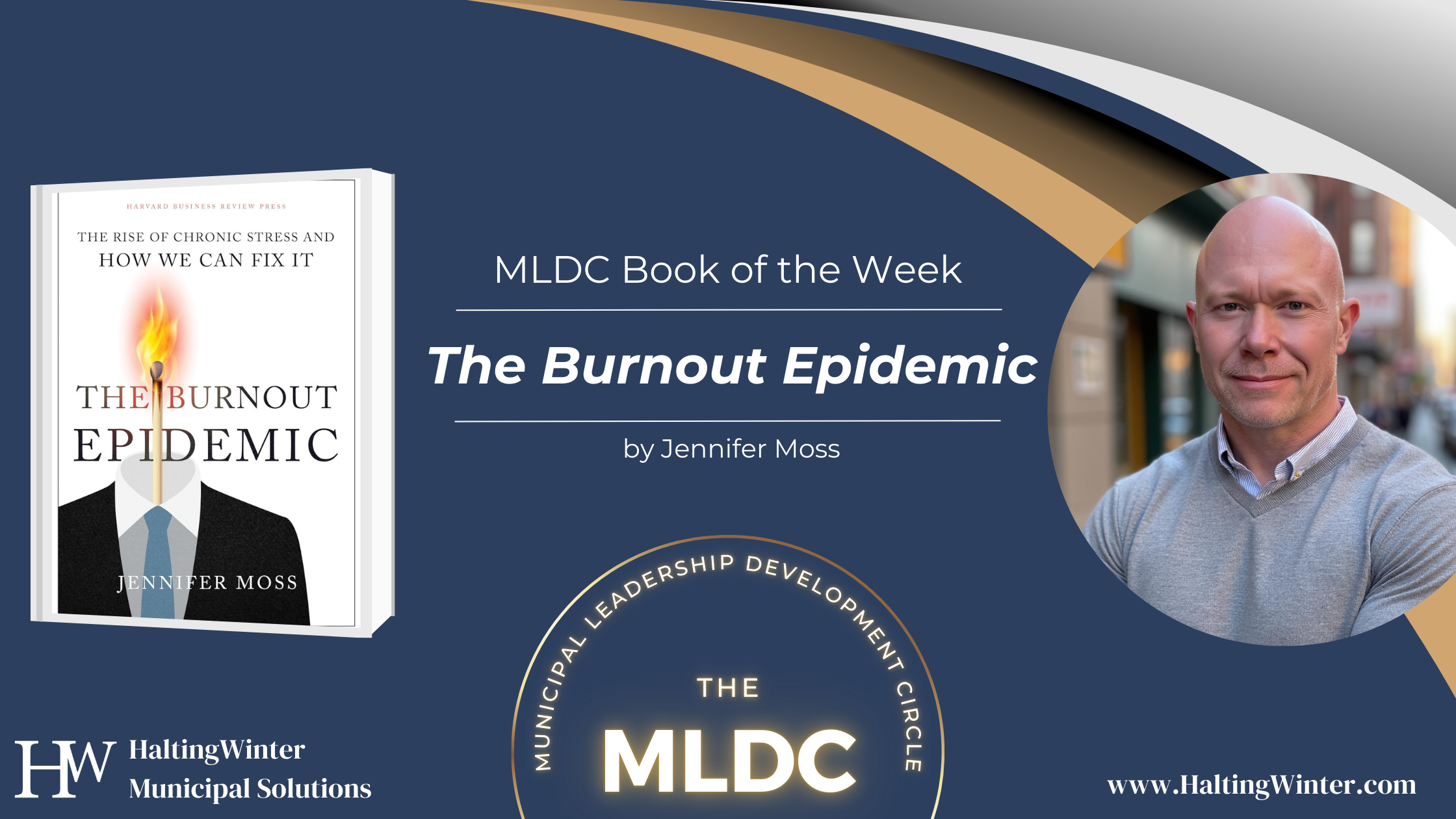
This week in the Municipal Leadership Development Circle (MLDC), we’re exploring “The Burnout Epidemic: The Rise of Chronic Stress and How We Can Fix It” by Jennifer Moss. And if you’re a city manager, county administrator, or department head watching your best people burn out despite every wellness initiative you’ve tried, this book is going to challenge everything you thought you knew.
You’ve seen it happen.
The brilliant new hire with impressive credentials struggles after six months. The long-serving employee who started at the bottom is now solving problems no one else can touch.
Council rejects a proposal you’ve worked on for years. Some leaders mentally draft resignation letters. Others start thinking about how to approach it differently next time.
How do you explain the difference?
You know that comprehensive plan your council wants? The one you’ve had on your calendar for six weeks? Still not done.
That organizational restructure that would actually solve your capacity problems? Still in draft form.
The performance system redesign your department desperately needs? Still on the “someday” list.
It’s not because you’re lazy. It’s not because you don’t care. It’s because you’re trying to do deep, strategic work in an environment designed for constant distraction.
When’s the last time you made a decision you regretted?
Not a catastrophic mistake. Just something where you looked back later and thought, “If I’d had ten more minutes to think about that, I would’ve handled it differently.”
Now ask yourself: Were you hurrying when you made it?
Every January, leaders feel the pressure to “get balanced.”
New routines.
New habits.
New expectations.
But if you lead in local government, you already know the truth: the work doesn’t slow down because the calendar flips. The weight doesn’t disappear because intentions are good. And balance, at least the way it’s been sold, has never quite fit the reality you live in.
You know that situation you’re facing right now? The one that feels impossible?
What if the problem isn’t the situation itself, but the story you’re telling yourself about it?