Municipal Leaders: Develop Faster, Lead Stronger, Build Better

Every week, you’ll get insights and actionable steps to help you navigate personal growth and professional success.

There’s a moment in American history that still doesn’t quite make sense on paper.
In 1860, Abraham Lincoln won the Republican nomination for president over three men who were better known, better connected, and, by almost every measure available at the time, were more qualified for the job than he was. William Seward had been a sitting senator and governor. Salmon Chase was a nationally respected statesman. Edward Bates had a reputation as one of the sharpest legal minds in the country.
Lincoln beat all three. And then he gave them seats in his cabinet.
Secretary of State. Secretary of the Treasury. Attorney General. The most powerful positions in his administration, handed to the men who believed, with good reason, that they should have been the one giving orders instead of taking them.
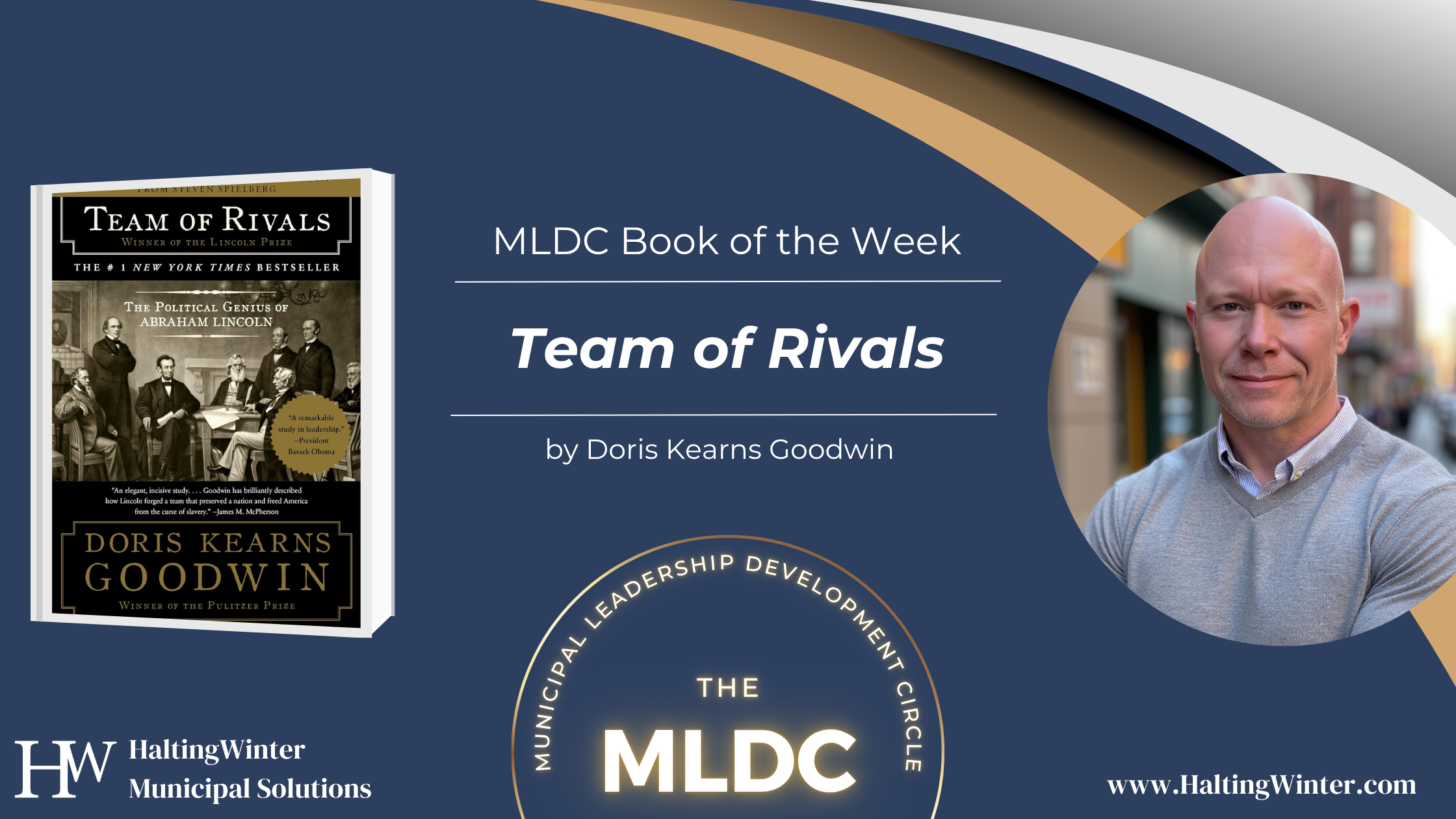
This is the story at the center of Doris Kearns Goodwin’s Team of Rivals: The Political Genius of Abraham Lincoln, and it’s the book we’re spending this week with on the MLDC, as part of our Summer Series, Stories That Shape Leaders.
A Cabinet Built to Fail
Every political instinct of the era said Lincoln had made a mistake. You don’t hand power to people who tried to take your job. You surround yourself with loyalists — people who think the way you think, who won’t second-guess you in front of others, who make the job easier rather than harder.
Lincoln didn’t operate that way. He wanted the most capable people in the country working for the Union, even if, especially if, those people had spent the campaign season explaining why he wasn’t fit to lead it.
What followed was one of the most difficult and consequential presidencies in American history, managed by a cabinet that, by every reasonable expectation, should have torn itself apart. Salmon Chase spent much of his tenure as Treasury Secretary quietly maneuvering to replace Lincoln on the next ticket. Edwin Stanton, who became Secretary of War, had once publicly humiliated Lincoln in a courtroom and made no secret of his early contempt for him.
And yet the cabinet held. Through a civil war, through devastating losses, through public criticism that would end most modern careers in a matter of weeks.
What Actually Held It Together
Goodwin’s research points to something that surprises a lot of readers. It wasn’t Lincoln’s political skill alone, and it wasn’t simply the gravity of the moment. It was Lincoln himself…specifically, the consistency of his character under pressure.
He listened more than he spoke. He gave credit away freely and took blame onto himself when things went wrong, even when the failure wasn’t his to own. He made time for the people around him, even the ones who didn’t think he deserved their respect. And he never stopped trying to understand what the people closest to him needed, feared, or were trying to protect.
None of that made him a pushover. He made hard calls that cost him relationships and political capital. But the people around him, even the ones who started out as rivals, came to trust him in a way that outlasted their disagreements.
By the end, Seward—the man who had once assumed he would be running the administration from behind the scenes—wrote home to his wife with a simple verdict: Lincoln was “the best of us.”
That’s not the kind of thing political maneuvering produces. That’s what character produces, over years, in front of people who are paying close attention.
Why This Story Matters Beyond History
You don’t have to be running a country to recognize the dynamics in this book. Anyone leading inside a complicated organization, with competing interests, limited resources, and people watching closely to see who you really are under pressure, will find something familiar in Lincoln’s story.
This week, inside the Municipal Leadership Development Circle (MLDC), we’re spending five days unpacking what this book has to offer leaders navigating exactly that kind of environment: city managers, county administrators, and department heads who lead through politics, budget constraints, and competing priorities every day.
If you lead people, manage competing interests, or navigate the kind of pressure that comes with public service, there’s something in this book for you.
Want the Full Week?
This post is just the opening. Inside the MLDC, members get a full week of content built around this book—one focused idea each day, with real, practical application for the work of local government leadership.
If you’re a city manager, county administrator, or department head looking for leadership development that actually speaks to the world you operate in, join us at HaltingWinter.com/MLDC.
Team of Rivals is a long book. It’s worth every page.
The Municipal Leadership Development Circle (MLDC) is a professional growth community exclusively for city/county managers, administrators, and local government leaders. Each week, we explore insights from transformative books and apply them specifically to the unique challenges of municipal leadership. Join Seth Winterhalter, President of HaltingWinter Municipal Solutions, and leaders from across North America to build stronger cities through stronger leaders. Learn more at HaltingWinter.com/MLDC.