Municipal Leaders: Develop Faster, Lead Stronger, Build Better
Every week, you’ll get insights and actionable steps to help you navigate personal growth and professional success.

All summer, the MLDC has been inside stories. Stories of leaders who built something lasting when the conditions were impossible. Who found a way forward when the path disappeared. Who refused to let circumstance determine outcome. The Summer Series — Stories That Shape Leaders — was designed to do exactly what great stories always do: expand what feels possible.
Now comes the harder question.
Inspiration is where it starts. But at some point, every leader has to walk back into a real organization, with real budget constraints, real council dynamics, real staff limitations, and a calendar that never stops, and actually make something change. That’s where most leadership development stops short. And that’s exactly where this fall begins.
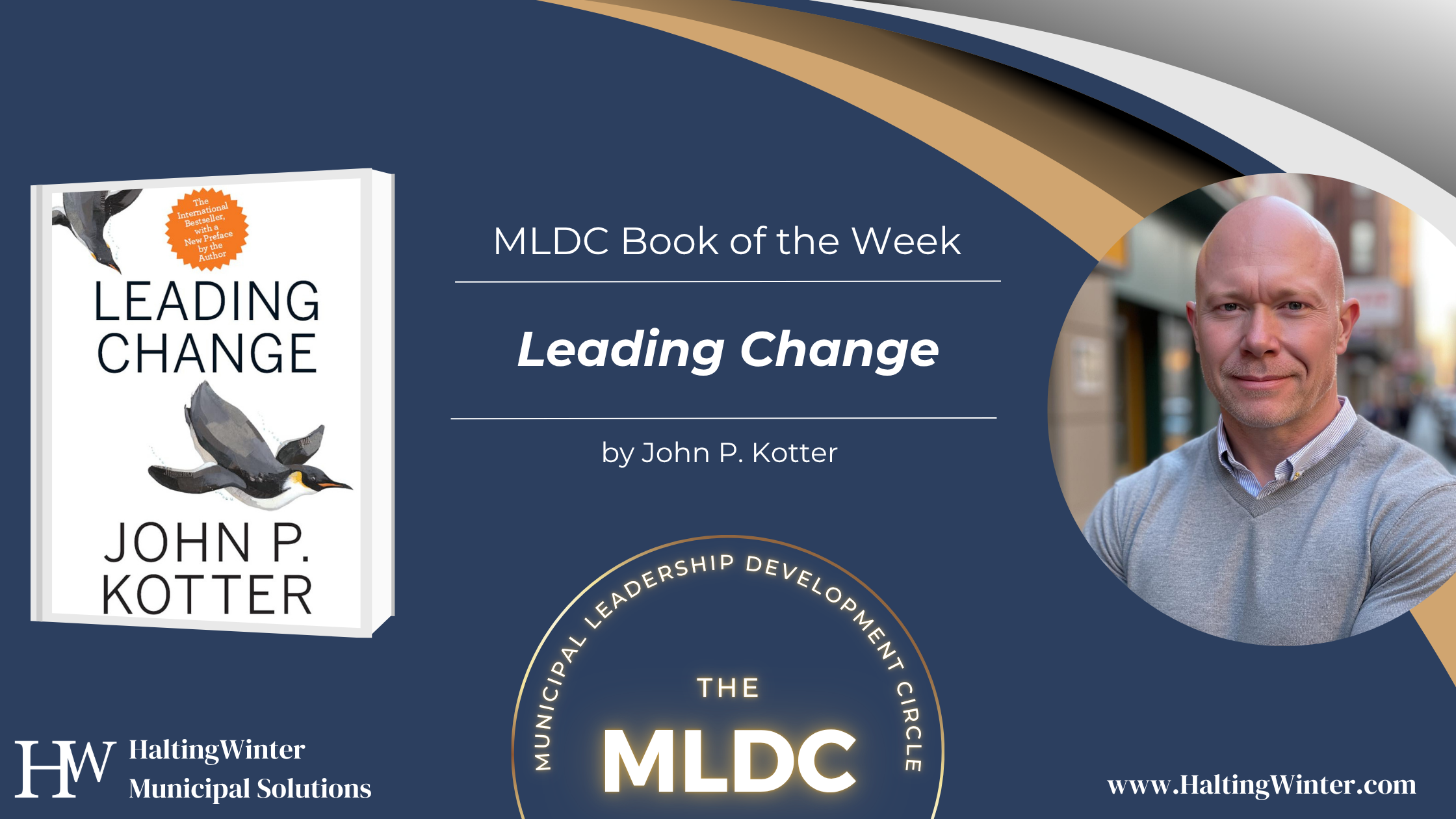
This Week’s MLDC Book: Leading Change by John Kotter
Kotter spent decades at Harvard Business School studying one question: why do so many organizational change efforts fail and what does it actually take to make transformation stick?
His answer wasn’t a strategy problem. It was a leadership problem.
The organizations he studied didn’t collapse because they had the wrong idea. They collapsed because leaders skipped the foundational work: building urgency before announcing the plan, assembling the right people before the resistance appeared, communicating far longer and far wider than felt necessary, and anchoring new behavior in culture before declaring victory.
Each skipped step compounded the next. And most leaders didn’t realize which step they’d missed until the initiative was already gone.
Here’s what makes Leading Change land differently for local government leaders than it does for anyone else.
In the private sector, urgency has a delivery mechanism. Markets shift. Competitors move. Revenue misses. The pressure arrives uninvited and people respond. In local government, that mechanism doesn’t exist. Civil service structures, long organizational tenure, elected oversight, and annual budget cycles all default toward stability, which means the urgency that drives change in the private sector never shows up on its own here.
You have to build it.
This week inside the MLDC, we’re working through five of the book’s most powerful insights: one each day, Monday through Friday, each one built specifically for the local government context. Not adapted loosely. Built deliberately for the people in your seat.
Content is part of what the MLDC offers. But it’s not the whole thing.
The deeper value is the community…city managers, county administrators, and department heads from across North America who show up every week inside the same space, working through the same ideas, asking the same honest questions about what it means to lead in local government when the work is hard and the support is thin.
Leadership at this level can be isolating. The problems are complex, the politics are real, and the number of people who genuinely understand your context is smaller than it should be. The MLDC exists to close that gap, to give local government leaders a place where the conversation is honest, the development is practical, and the community actually knows what your seat feels like.
Learn More and Join the MLDC at HaltingWinter.com/MLDC
The Municipal Leadership Development Circle (MLDC), led by Seth Winterhalter, is a community for city and county managers, administrators, and local government leaders who believe leadership shouldn’t be carried alone. Through trusted peer relationships, candid conversations, and practical leadership development, the MLDC creates space for municipal leaders to think differently, grow intentionally, and navigate the challenges of leadership alongside people who understand the weight of the work. Learn more at HaltingWinter.com/MLDC.