Municipal Leaders: Develop Faster, Lead Stronger, Build Better

Every week, you’ll get insights and actionable steps to help you navigate personal growth and professional success.

There’s a specific kind of exhaustion that shows up in high-performing local government leaders. It isn’t burnout from doing too little. It’s the fatigue of doing a lot: closing budget gaps, filling vacant positions, navigating a difficult council relationship, finally getting a long-delayed capital project off the ground, and somehow never feeling caught up. The to-do list gets shorter, yet the feeling of being behind doesn’t improve.
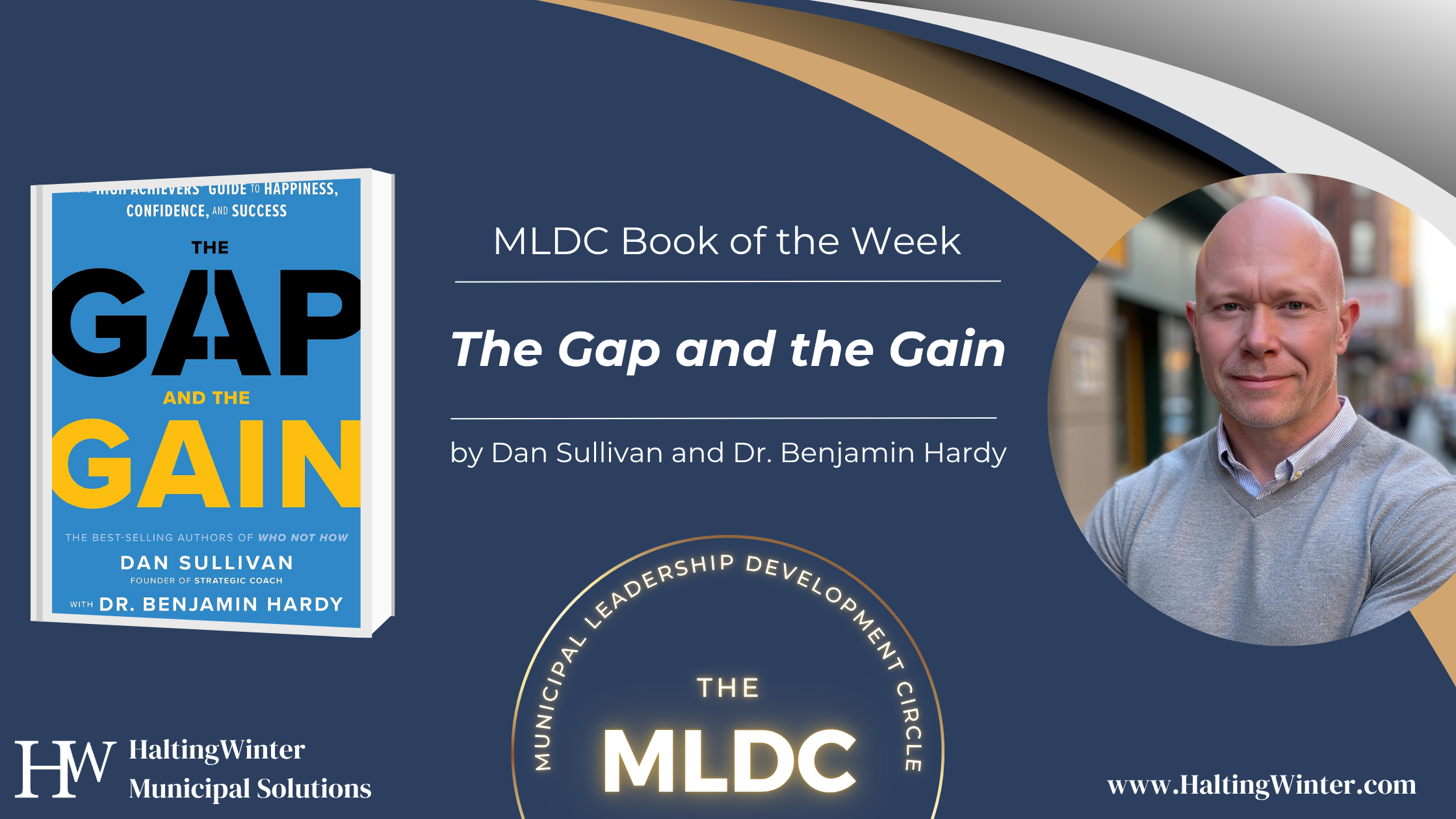
The Gap and the Gain, by Dan Sullivan and Dr. Benjamin Hardy, has a straightforward explanation for that feeling, and it isn’t about work ethic, resilience, or how many hours you’re putting in. It’s about math. Specifically, which direction you’re measuring in.
Sullivan, who has spent over three decades coaching entrepreneurs, built this idea around a pattern he kept seeing in his most accomplished clients: successful people evaluating themselves against an “ideal” that, by its nature, is always somewhere out ahead of them: a fully staffed department, a unanimous council vote, a budget with room to spare, a community with zero complaints. Measured that way, almost nobody wins, ever, regardless of how much real progress they’ve made, because the target keeps resetting itself the moment it’s within reach. Hardy, an organizational psychologist, brings the research behind why this pattern is so costly, not just to day-to-day motivation, but to long-term stress and physical well-being.
Here’s why this hits differently in local government than it does in the business world this book was written for. Public sector leaders don’t get a stock price or a quarterly earnings call to point to as proof of progress. Budgets never stretch as far as the need. The public rarely calls to say things are going well. It’s a job structurally built to keep you feeling behind, which means the wins are real, but they’re often invisible unless someone deliberately goes looking for them and names them out loud.
This week, MLDC members are working through five specific takeaways from The Gap and the Gain: real, applicable action steps for measuring your own progress honestly, built for council dynamics, budget cycles, and the day-to-day weight of this job, not the job of a founder chasing an exit. Not theory. Not a framework you’ll forget by Friday. Five days of insight, plus a conversation guide built to take straight into your next leadership meeting or team check-in.
That’s also the deeper reason MLDC exists. Leading with this kind of self-awareness is hard to do alone and most local government leaders don’t have a peer down the hall who’s wrestling with the same question of whether they’re actually failing or just measuring wrong. Inside MLDC, you get that peer group: city managers, county administrators, and department heads from across North America working through the same leadership material, in the same week, so you’ve got somewhere to bring the parts of the job that don’t fit neatly into a staff meeting.
Join us at HaltingWinter.com/MLDC.
The Municipal Leadership Development Circle (MLDC), led by Seth Winterhalter, is a community for city and county managers, administrators, and local government leaders who believe leadership shouldn’t be carried alone. Through trusted peer relationships, candid conversations, and practical leadership development, the MLDC creates space for municipal leaders to think differently, grow intentionally, and navigate the challenges of leadership alongside people who understand the weight of the work. Learn more at HaltingWinter.com/MLDC.