Municipal Leaders: Develop Faster, Lead Stronger, Build Better

Every week, you’ll get insights and actionable steps to help you navigate personal growth and professional success.

There’s a moment in the 1936 Berlin Olympics that still gives me chills.
Nine young men—sons of loggers, shipyard workers, and farmers from the Pacific Northwest—sit in a wooden boat, about to race for gold in front of Adolf Hitler and a crowd expecting a German victory. They weren’t the biggest. They weren’t the most celebrated. And they won anyway, not by outworking everyone in the final stretch, but because something clicked in that boat that the other crews couldn’t manufacture.
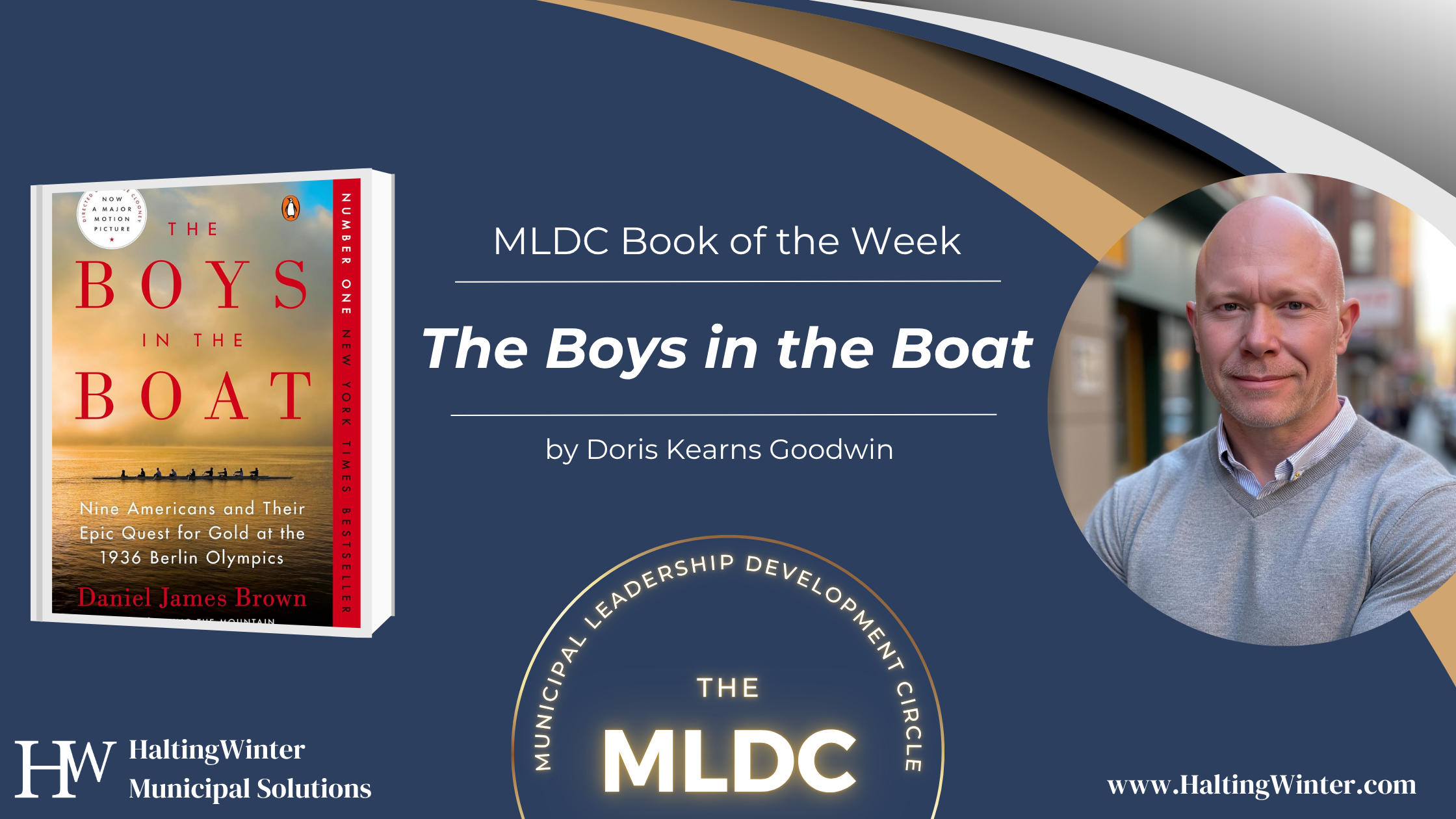
That story is the foundation of The Boys in the Boat by Daniel James Brown and it’s our second book inside this summer’s series, Stories That Shape Leaders.
This summer, we’re doing something a little different inside the MLDC. Instead of working through traditional leadership frameworks, we’re spending each week with a story, a narrative nonfiction that reveals leadership principles through real human experience instead of bullet points and case studies.
The Boys in the Boat is the perfect place to continue. It’s the true story of the University of Washington’s eight-oar crew, clawing their way from obscurity during the Great Depression to an Olympic gold medal against crews with far more money and far more institutional support. The emotional center of the book is Joe Rantz, a young man with more raw talent than almost anyone on the team, who nearly didn’t make the boat at all. Not because of his ability. Because he couldn’t bring himself to trust the people rowing next to him.
His turning point comes from George Pocock, the boat builder and quiet mentor of the entire program, who tells Joe something that changes everything: a crew isn’t eight people rowing hard in the same direction. It’s one organism. And the moment you stop trying to carry it alone is the moment it actually starts to move.
That idea, and several others in this book, translate directly into the work of leading in local government. Your constraints are real. Your resources are limited. The pressure is constant. And the leaders who build something extraordinary inside those conditions are the ones who learn what Joe Rantz had to learn: trust isn’t optional. It’s the whole game.
This week, inside the MLDC, we’re spending five days with this book — one idea each day, working through what trust, feedback, adversity, and full investment actually look like for the people leading cities, counties, and departments right now.
If you’ve been on the fence about joining the Municipal Leadership Development Circle, this is a great week to come see what we do. We don’t deal in generic leadership advice. Every week, we take the best ideas from books like this one and build them specifically for the realities of local government…the council dynamics, the budget constraints, and the community expectations that don’t always match the resources you have to work with.
Come row with us this week.
Join the MLDC at HaltingWinter.com/MLDC.
The Municipal Leadership Development Circle (MLDC) is a professional growth community exclusively for city/county managers, administrators, and local government leaders. Each week, we explore insights from transformative books and apply them specifically to the unique challenges of municipal leadership. Join Seth Winterhalter, President of HaltingWinter Municipal Solutions, and leaders from across North America to build stronger cities through stronger leaders. Learn more at HaltingWinter.com/MLDC.