Municipal Leaders: Develop Faster, Lead Stronger, Build Better

Every week, you’ll get insights and actionable steps to help you navigate personal growth and professional success.

Are you exhausted from trying to be everything to everyone?
Do you feel like you’re supposed to be a budget wizard, crisis communication expert, strategic visionary, and community relations master all rolled into one superhuman city manager?
Are your best people leaving because they’re tired of being told to fix their weaknesses instead of using their strengths?
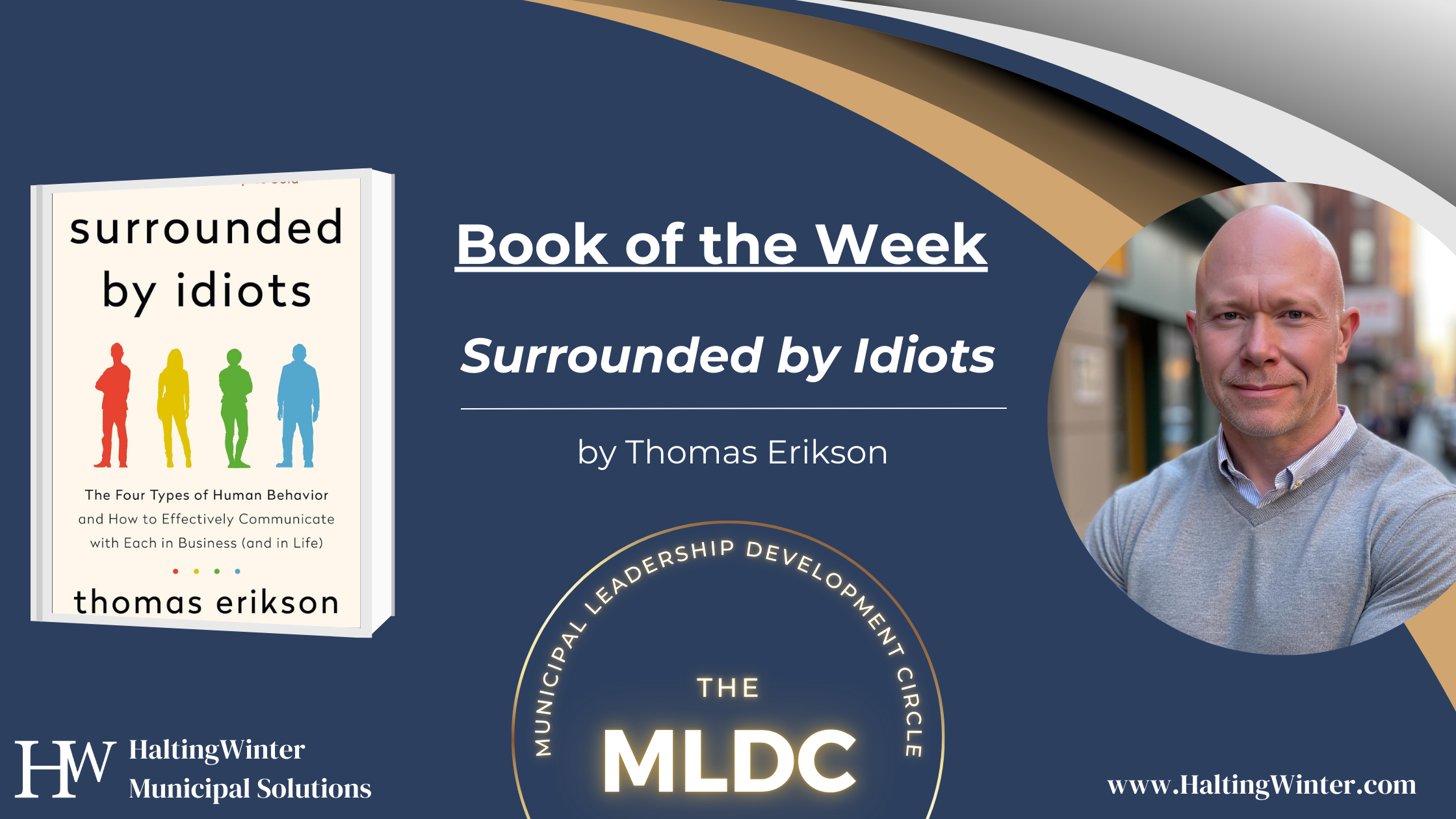
This week, we’re exploring Thomas Erikson’s “Surrounded by Idiots,” a fascinating guide to understanding the four personality types that shape every interaction in your professional life. Based on the proven DISC behavioral model, this book reveals why smart people often seem to completely miss each other’s points and provides a practical framework for communicating effectively with anyone.
You’ve balanced another budget. Completed another major project. Navigated another political crisis. Your performance metrics look strong, your council is satisfied, and your community is growing. By every traditional measure, you’re succeeding.
So why do you feel like you’re failing at what matters most?

You know what good leadership looks like. You’ve read the books, attended the workshops, and genuinely care about serving your community well. But when the pressure hits—budget crises, council conflicts, emergency situations—do you find yourself making decisions that don’t align with your stated values?
Your last leadership team meeting ran two hours over schedule. Again. Despite having some of the most qualified department heads in the region, decisions still feel like negotiations. Staff can recite your mission statement but can’t explain how their daily work connects to it. And that customer service initiative you launched three months ago? Half your employees still default to the old way of doing things.
If this sounds familiar, you’re not alone—and you’re not failing.
Every week, municipal leaders across North America face the same frustrating reality: despite having compelling data, solid proposals, and genuine passion for community service, their most important messages fall flat.
Council members glaze over during budget presentations. Citizens disengage from critical infrastructure discussions. Staff meetings feel disconnected from the mission that brought everyone to public service in the first place. The harder you push facts and figures, the more resistance you encounter.
This isn’t a failure of logic. It’s a failure of connection.
The federal grant you’ve relied on for three years just got eliminated. Your most experienced department head announced their retirement with two weeks’ notice. New state regulations completely changed how you deliver core services to your community.
Welcome to Summer 2025!
This week, we’re diving into Spencer Johnson’s “Who Moved My Cheese?” – a deceptively simple parable that offers profound insights for municipal leaders navigating the constant change that defines local government.
Every municipal leader knows the frustration: a simple community need that should take weeks to address somehow requires months of procedures, approvals, and departmental coordination. Good intentions have accumulated into bureaucratic barriers that prevent the very outcomes you’re trying to achieve.
Your Monday morning department head meeting sounds like a support group for municipal leaders dealing with impossible circumstances.
“The council doesn’t understand what we actually do.”
“Citizens expect miracles with no resources.”
“If they’d just listen to us, none of this would be happening.”
Everyone nods sympathetically. The complaints feel valid. The frustrations are real.
You’re standing before council during budget deliberations when a member challenges your transparency while questioning your department’s spending patterns. Your response in this moment—and a thousand others like it—determines whether you lead with credibility or struggle with constant skepticism.