Municipal Leaders: Develop Faster, Lead Stronger, Build Better
Every week, you’ll get insights and actionable steps to help you navigate personal growth and professional success.

It’s late Tuesday evening, and you’re the last one in city hall. On your desk sits a stack of congratulatory messages about your city’s recent bond rating upgrade. Down the hall, your team has just wrapped up another successful council presentation. By most measures, your city is doing well. Yet something nags at you – a persistent question: “How do we move from good performance to truly great impact?”

As municipal leaders, you will often find yourself navigating between “good enough” and truly exceptional service delivery. In this week’s episode of the HaltingWinter Podcast, we dive deep into Jim Collins’ revolutionary concepts from “Good to Great” and explore their powerful applications in municipal government.
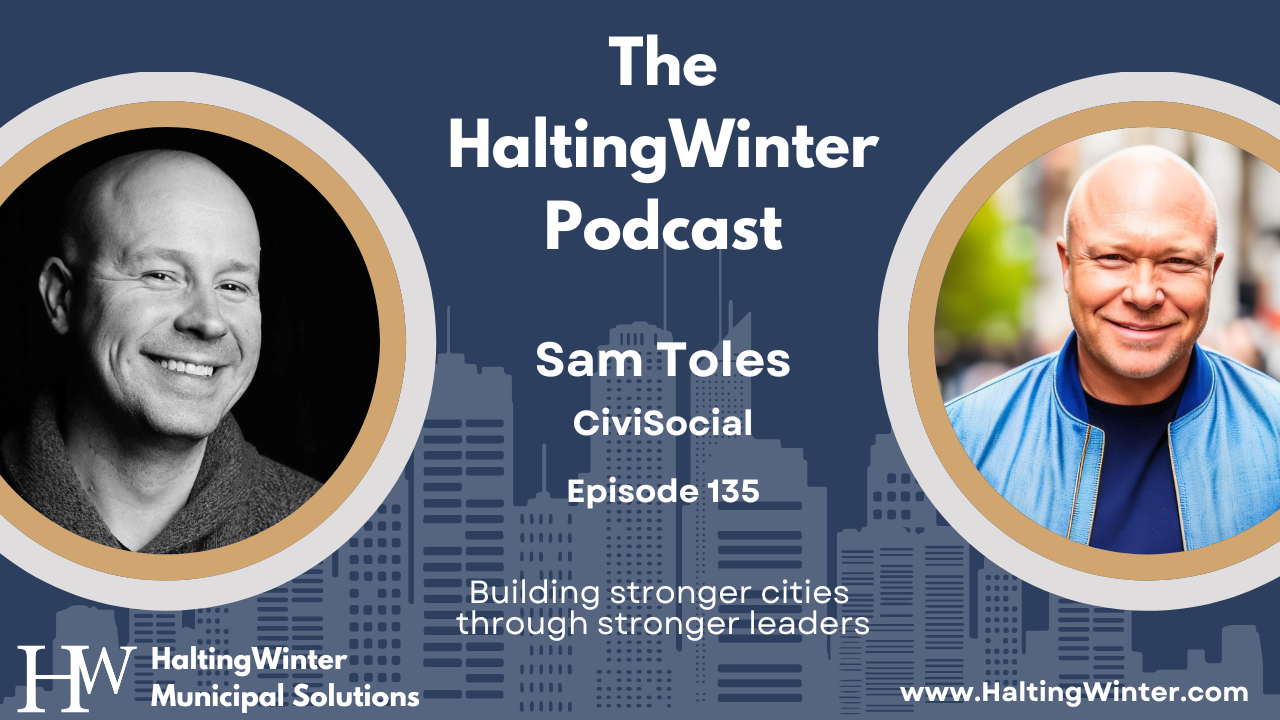
In the latest episode of The HaltingWinter Podcast, we dive into an extraordinary conversation with Sam Toles, CEO of CiviSocial, whose journey from Hollywood executive to municipal communications innovator offers groundbreaking insights for city leaders.
Sam’s career spans roles at MGM, Bleacher Report, and working with leading content creators like Mr. Beast. But what makes his perspective truly unique is how he’s translated these high-level media insights into practical strategies for local governments.
Are you quietly questioning whether your employee recognition programs and incentive systems are actually working? You’re not alone. As municipal leaders, many often find themselves implementing the same motivation strategies that have been used for decades – but what if there’s a better way?
In this week’s episode of The HaltingWinter Podcast, Seth Winterhalter challenges conventional wisdom about motivation in municipal government, drawing powerful insights from Daniel Pink’s “Drive: The Surprising Truth About What Motivates Us.” Through real-world examples and surprising research, we explore why traditional approaches to motivation often backfire in public service – and what actually works.
Imagine: It’s Monday morning, and a city manager is staring at the latest employee engagement survey results. Despite implementing performance bonuses, employee-of-the-month programs, and standardized recognition initiatives, engagement scores remain stagnant. Department heads report increasing difficulty motivating their teams, and the traditional “if-then” rewards aren’t moving the needle on performance or satisfaction.

Welcome to this week’s edition of “The Leader’s Lens!” This week at HaltingWinter Municipal Solutions, we explored Peter Drucker’s timeless wisdom from “The Effective Executive” through the unique lens of municipal leadership. If you enjoyed Monday’s public content, consider joining the Municipal Leadership Development Circle (MLDC) to access the complete five-part series, including four additional deep-dive articles and the full podcast exploration. MLDC members receive weekly insights from influential leadership books all year long, translated specifically for municipal context. [Learn More Here]
When you think of the typical career path to city administration, you probably don’t envision thirty years of Friday night football broadcasts, owning the local newspaper, and having family roots that stretch back to 1895. But for Monte Walker, City Administrator of Howe, Texas, this unique combination of experiences created a leadership perspective perfectly suited for guiding his hometown through transformative change.

It’s 7:30 AM. You’re already at your desk, coffee in hand, reviewing the stack of reports due for tomorrow’s council meeting. Your calendar shows back-to-back meetings until 5 PM, including a sensitive personnel issue, a budget review, and a community group presentation. Your phone buzzes – the public works director needs an urgent decision about equipment repairs. Welcome to another day as a city manager.
In this constant whirlwind of demands and decisions, one question becomes critical: Are you being effective?
Are you trapped in the productivity paradox? As municipal leaders, you might often pride yourself on being the first in, last out, and handling multiple crises simultaneously. But what if this dedication to productivity is actually holding you back from true leadership effectiveness?
In this week’s episode of The HaltingWinter Podcast, Seth Winterhalter challenges our fundamental understanding of municipal leadership with insights from Peter Drucker’s “The Effective Executive.” Through a compelling story of a city manager caught in the productivity trap, we explore why doing things right isn’t the same as doing the right things.
Hello, Impactful City Leaders!
Welcome to this week’s edition of “The Leader’s Lens!” This week at HaltingWinter Municipal Solutions, we explored the transformative power of emotional intelligence in municipal leadership through Daniel Goleman’s groundbreaking book. The insights couldn’t be more timely as city leaders navigate increasingly complex stakeholder dynamics and organizational challenges.