Municipal Leaders: Develop Faster, Lead Stronger, Build Better
Every week, you’ll get insights and actionable steps to help you navigate personal growth and professional success.

You’re sitting in your office, staring at the performance review you need to write. The department head across the hall has been declining for months. Reports are late. Quality has slipped. Their team is compensating, and it’s showing in their morale.
You know exactly what needs to be said. But you’ve been putting off this conversation for six weeks.
You tell yourself you’re waiting for the right time. That they’re going through a difficult period. That you don’t want to damage a relationship you depend on. That it’s complicated: civil service protections, political connections, and union considerations.
But here’s the truth: while you’re being “nice,” services are suffering. Your credibility is eroding. And the person who needs your honest feedback is heading toward a crisis you could have prevented.
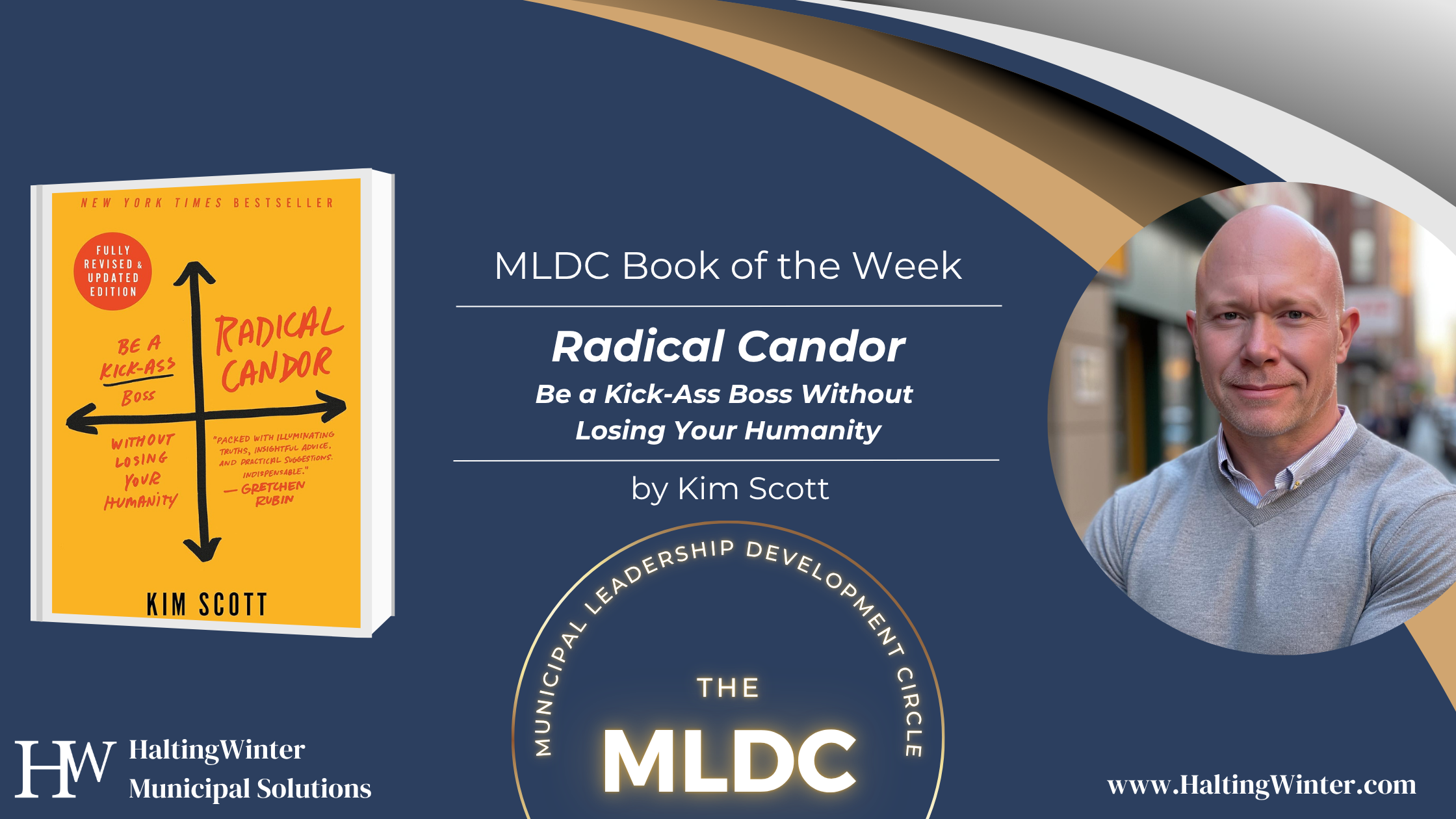
This is the leadership trap that Kim Scott identifies in Radical Candor and it’s this week’s focus in the Municipal Leadership Development Circle.
Let me describe what’s most likely happening in your organization right now.
You have talented people who’ve stopped growing because no one tells them specifically what they’re doing well. You have struggling employees who don’t improve because your feedback is too vague to act on. You have decisions that take forever because you’re managing around performance problems instead of addressing them.
You spend hours crafting careful emails because you’re worried about documentation. You rehearse difficult conversations until you’ve talked yourself out of having them. You sandwich criticism between praise until your actual message gets lost completely.
And it’s not because you don’t care. You care deeply. That’s exactly the problem.
You care so much about relationships, about not hurting feelings, about maintaining harmony, that you withhold the honesty people actually need to succeed. Kim Scott calls this Ruinous Empathy and it’s the most common leadership failure in local government.
Meanwhile, the pressures you face make this worse. Political relationships feel too fragile for candor. Civil service systems make every conversation feel legally risky. Union dynamics complicate directness. Public scrutiny amplifies every word. Time constraints make “later” feel safer than “now.”
So you default to being nice. Understanding. Patient. You think you’re being supportive.
You’re not. You’re being convenient, choosing your comfort over their success.
Every day you postpone that difficult conversation, the problem compounds. Small performance issues become termination-worthy crises. Talented people leave because they’re compensating for colleagues who aren’t held accountable. Council loses confidence because they see problems you won’t address.
And the person you’re trying to protect? You’re actually abandoning them. They know something’s wrong. Your vague reassurances create confusion, not comfort. The disconnect between your words (“Everything’s fine”) and their reality (“Something feels off”) generates anxiety.
When you finally have the conversation—and you will have to have it eventually—it’s much harsher than it needed to be. Because six months of accumulated frustration comes out. Because the problem is now urgent instead of addressable. Because you’ve lost the opportunity for course correction and now you’re managing consequences.
Your silence didn’t protect anyone. It just delayed the inevitable while making it worse.
This is costing your community more than you realize. Residents deserve high-performing teams. Elected officials need your honest professional advice. Your staff needs clarity about expectations and performance. None of that happens when you prioritize comfort over candor.
Kim Scott’s framework provides the breakthrough you need. She proves that you don’t have to choose between caring about people and challenging them directly. The best leaders (the most effective leaders) do both simultaneously.
The framework is built on two dimensions: Care Personally and Challenge Directly.
When you combine both, you achieve Radical Candor: you build strong relationships AND you tell people the truth. You invest in knowing your team members as whole humans, understanding their goals and challenges beyond work. And because you’ve built that foundation of genuine care, you can be direct about their performance without them questioning your intentions.
But when you care without challenging—Ruinous Empathy—you think you’re being kind, but you’re actually being unclear. You’re withholding the feedback people need because you’re uncomfortable delivering it.
When you challenge without caring—Obnoxious Aggression—you damage people by criticizing without context, attacking publicly, or focusing solely on failures without acknowledging the human receiving your feedback.
When you do neither—Manipulative Insincerity—you tell people what they want to hear while complaining behind their backs. You avoid both honesty and connection.
Scott’s insights are compelling: the caring thing, the genuinely kind thing, is to tell people the truth. Clarity is kindness. Ambiguity is cruelty.
And feedback should be normal—a frequent practice of specific praise and immediate correction, not something saved for annual reviews or crisis moments.
This week in the Municipal Leadership Development Circle (MLDC), we’re translating Radical Candor specifically for local government leadership. We’re not giving you generic business advice; we’re addressing your unique context.
Monday, we establish the foundation: why Ruinous Empathy is the default trap for local government leaders, and what it’s costing your community.
Tuesday, we dive deep into caring personally: what it actually means in professional contexts, how to show genuine care without crossing boundaries, and why this foundation is essential for everything that follows.
Wednesday, we explore challenging directly: how to give feedback that’s specific, immediate, and helpful rather than vague, delayed, or attacking.
Thursday, we examine the four quadrants in depth: how to recognize your patterns under different pressures, which relationships trigger which responses, and how to choose Radical Candor even when your default pulls you elsewhere.
Friday, we make it actionable: how to start practicing Radical Candor this week with your team, despite all the constraints you face.
Plus, you’ll receive a conversation guide to use with your leadership team, exploring these concepts together and building shared commitment to honest feedback cultures.
Every piece is written specifically for city managers, county administrators, department heads, and municipal leaders. Every scenario reflects the realities you navigate daily. Every insight accounts for the political, legal, and operational complexities of local government.
Here’s what you need to understand: the conversation you’re avoiding right now will not get easier with time. The performance problem won’t resolve itself. The talented person compensating for weak colleagues won’t wait forever. Your credibility with council won’t magically restore.
The only path forward is developing the capacity to care personally and challenge directly: to be both supportive and honest, both invested and direct, and both kind and clear.
Kim Scott’s Radical Candor gives you permission to stop choosing between effectiveness and empathy. You can demand high performance while treating people with dignity. You can hold people accountable while investing in their success. You can tell the truth while strengthening relationships.
This week, join local government leaders from across North America in the Municipal Leadership Development Circle. Access all five blog posts, all five podcast episodes, and the team conversation guide. Engage with a community that gets your challenges because they’re facing the same ones.
Every week, we explore a new leadership book, translating insights specifically for local government, providing practical tools, creating space for peer learning and support.
This week, it’s Radical Candor. Next week, another book with breakthrough insights. Every week, we’re getting better at leading the organizations our communities deserve.
Your community is counting on you to build high-performing teams. Your staff deserves leaders who care enough to tell the truth. The work requires you to stop choosing between being liked and being effective.
Start your annual MLDC membership now and get immediate access to this week’s complete content on Radical Candor, plus our entire library of leadership insights translated for local government.
Want to discuss membership options for yourself or your leadership team? Schedule a call with Seth to explore how the MLDC can support your development and your organization’s impact.
The conversation you’ve been avoiding needs to happen. The feedback you’ve been withholding needs to be delivered. The leadership your community needs requires both caring and candor.
This week, we’re learning how—together.
The Municipal Leadership Development Circle (MLDC) is a professional growth community exclusively for city managers, administrators, and local government leaders. Each week, we explore insights from transformative books and apply them specifically to the unique challenges of municipal leadership. Join Seth Winterhalter, President of HaltingWinter Municipal Solutions, and leaders from across North America to build stronger cities through stronger leaders. Learn more at HaltingWinter.com/MLDC.