Municipal Leaders: Develop Faster, Lead Stronger, Build Better

Every week, you’ll get insights and actionable steps to help you navigate personal growth and professional success.

You’ve been avoiding the conversation with that department head for three months now. You know the performance isn’t where it needs to be. You’ve hinted. You’ve suggested. You’ve hoped the issue would somehow resolve itself. Meanwhile, the rest of your leadership team is watching, adjusting their expectations, and learning that accountability is optional.
Or maybe it’s the opposite problem. You finally had the conversation, but it went sideways. You got defensive when they pushed back. The tension escalated. Now the relationship is damaged and the performance issue still isn’t resolved.
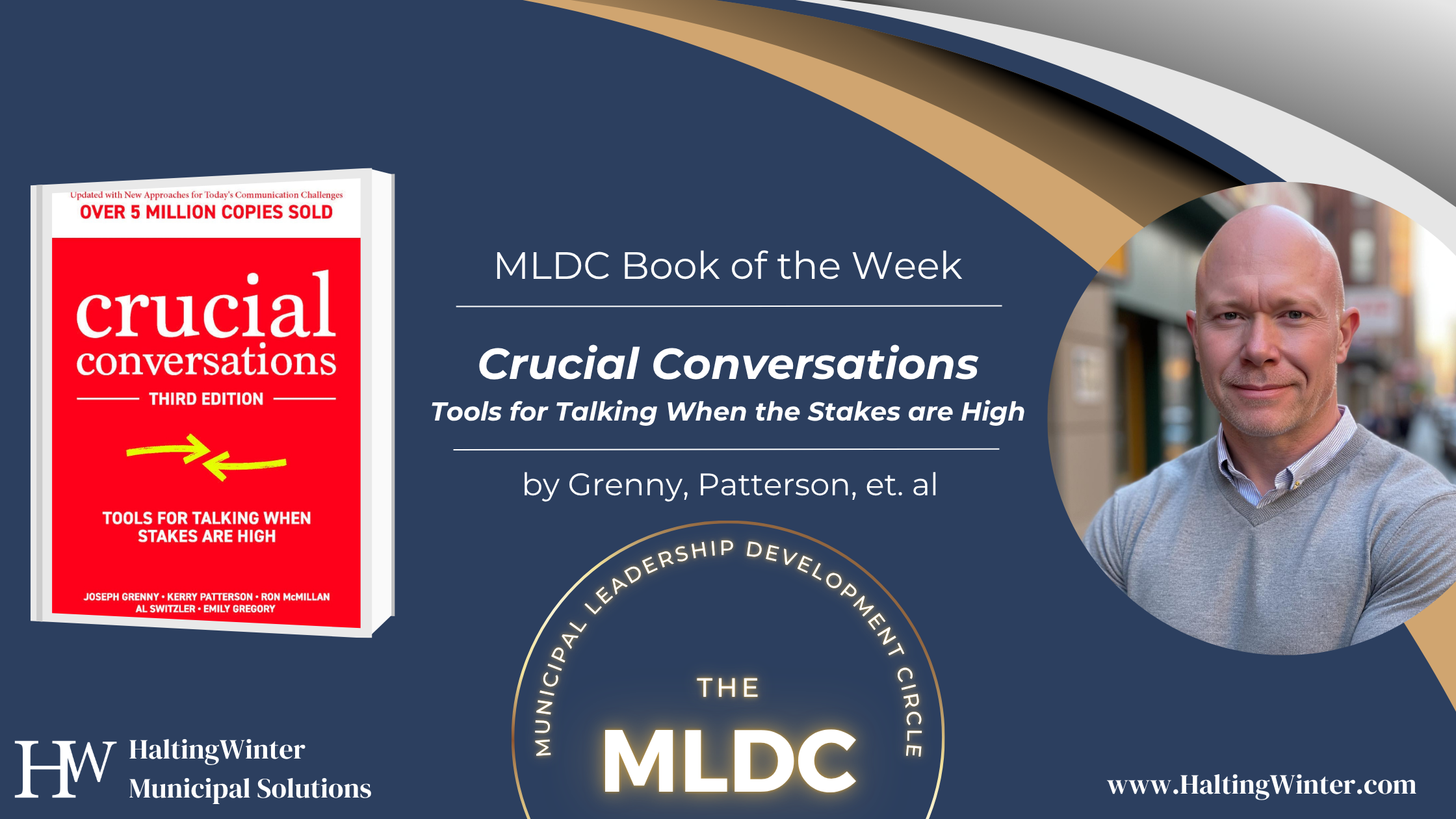
Here’s what Kerry Patterson, Joseph Grenny, Ron McMillan, and Al Switzer discovered in their research for Crucial Conversations: Tools for Talking When Stakes Are High: your career success and organizational effectiveness depend more on how you handle high-stakes dialogue than on virtually any other skill. Not your technical expertise. Not your years of experience. Not your strategic brilliance. Your ability to navigate conversations when opinions vary, stakes are high, and emotions run strong.
And most leaders—even highly competent ones—handle these conversations poorly.
Think about your reality as a local government leader. You face crucial conversations constantly:
With your council. You need to explain why their preferred timeline won’t work, but you’re worried about being seen as obstructive. Or you need to address a council member who’s undermining staff morale, but you’re calculating the political cost of that conversation.
With your staff. You have a long-tenured employee who’s not performing, but they’re politically connected and you’re not sure how to address it without creating bigger problems. Or your leadership team brings you every problem expecting you to solve it, and you’re drowning in issues that should be handled at lower levels.
With your community. You’re facing an angry public meeting about a controversial project. You know people are upset. And you’re trying to figure out how to engage without either getting defensive or letting the meeting devolve into chaos that undermines your credibility.
With other departments or jurisdictions. You need to coordinate across departments that protect their turf. Or you’re trying to build regional cooperation with leaders who see things completely differently than you do.
Every single one of these situations qualifies as a crucial conversation. High stakes. Differing opinions. Strong emotions.
And here’s the trap: when conversations become crucial, you default to one of two responses. You either go silent (avoiding the conversation, hinting around the issue, withholding what you really think) or you go to what the authors call violence (getting aggressive, forcing your position, becoming controlling or attacking).
Neither works.
When you avoid crucial conversations, problems don’t resolve—they multiply. That performance issue you’re not addressing? It’s getting worse. And your credibility as a leader who follows through is eroding with every week you wait.
When you handle them aggressively, you damage relationships you depend on. That council member you got defensive with? The relationship is now more strained, making your next initiative even harder.
The authors identify three vicious cycles that trap leaders who can’t navigate crucial conversations effectively:
You build over-dependent teams. When you avoid difficult conversations about accountability or decision-making, your team learns to bring you every problem. You become the bottleneck because you haven’t created the dialogue that develops their capability.
You become overwhelmed. Without the ability to have honest conversations about priorities, boundaries, and expectations, everything becomes your problem. You’re drowning in issues that should be handled by others.
You lose connection with reality. When people don’t feel safe being honest with you, you stop getting the information you need. Problems fester underground until they explode publicly.
Unlike private sector leaders, you can’t rely on positional authority. You don’t control your council; you advise them. You don’t control your community; you serve them. And even with your own staff, you’re navigating civil service protections, union relationships, and political sensitivities.
Your effectiveness depends almost entirely on your ability to influence through dialogue. To build relationships across lines of disagreement. To navigate difficult conversations skillfully enough that people want to work with you even when it’s hard.
But nobody taught you how to do this. You learned policy and finance and operations. You didn’t learn how to create safety when someone’s defensive. How to separate facts from the stories you tell yourself about people’s motives. How to speak honestly without destroying trust.
Patterson and his colleagues spent years studying people who navigate high-stakes dialogue effectively. They discovered specific, learnable skills that separate leaders who thrive from leaders who struggle:
Recognizing crucial conversations before they deteriorate. Most leaders don’t realize they’re handling a conversation poorly until after it’s over. The book teaches you to notice in real-time when dialogue is breaking down: when safety disappears, when people exit emotionally, and when you’re about to say something you’ll regret.
Creating safety even with adversaries. You can’t avoid difficult people in local government. That council member who questions everything will be there for years. The community activist who opposes your initiatives isn’t going away. The book shows you how to establish mutual purpose and mutual respect: how to create conditions where honest dialogue becomes possible even with people you struggle with.
Managing your stories. You’ve convinced yourself you know why people behave the way they do. That council member is playing politics. That employee doesn’t care. That community group is unreasonable. The book teaches you to question your own interpretations and stay curious instead of certain, because curiosity creates dialogue possibilities that certainty destroys.
Speaking persuasively without being aggressive. The book provides practical frameworks for sharing difficult truths in ways people can actually hear. For disagreeing while maintaining relationships. For being both clear and respectful.
This week, Municipal Leadership Development Circle (MLDC) members are diving deep into Crucial Conversations with content designed specifically for local government leaders.
Throughout the week, you’ll engage with other local government leaders from across North America who understand your constraints, your challenges, and your context. They’re navigating similar conversations with their councils, their staff, their communities. And they’re sharing what they’re learning, asking questions about their specific situations, and supporting each other in applying these skills.
If you’re tired of feeling frustrated by difficult conversations and if you’re ready to develop skills that will transform your effectiveness, join the Municipal Leadership Development Circle.
Start Your Annual MLDC Membership Now
Every week, we explore a different book, always translated specifically for local government leadership. Always with practical application. Always with a community of leaders who understand your reality.
Want to discuss membership options for yourself or your leadership team?
The Municipal Leadership Development Circle (MLDC) is a professional growth community exclusively for city managers, administrators, and local government leaders. Each week, we explore insights from transformative books and apply them specifically to the unique challenges of municipal leadership. Join Seth Winterhalter, President of HaltingWinter Municipal Solutions, and leaders from across North America to build stronger cities through stronger leaders. Learn more at HaltingWinter.com.